High Power Pistol - This article likely contains original research. Please improve by verifying the claims made and adding online citations. Statements consisting only of original research should be removed. (October 2022) (Learn more about how and when to remove this message template)
The Browning Hi-Power is a single-action semi-automatic pistol available in 9×19mm Parabellum and .40 S&W calibers. It was based on the design of American firearms inventor John Browning and was completed by Dieudonné Saive at FN Herstal. Browning died in 1926, several years before the design was completed. FN Herstal called it "High Power," referring to its 13-round magazine capacity, which was nearly double that of other designs of the time such as the Luger or the Colt M1911.
High Power Pistol
During World War II, Belgium was occupied by Nazi Germany and the FN factory was used by the Wehrmacht to manufacture pistols for its armies under the designation "9mm Pistol 640(b)".
Fn High Power, Danish Contract, M1946, Original Shipping Box, 119, I 705
FN Herstal continued to manufacture weapons for the Allied forces, moving the production line to the John Inglis and Company factory in Canada, which was renamed "Hi Power". The name change remained even after production returned to Belgium. The gun is often called HP or BHP,
And from the release of the pistol in 1935, the terms P-35 and HP-35 are also used. Other names include GP ("Grande Puissance" for the Frch term) or BAP (Browning Automatic Pistol). The Hi-Power is one of the most used military pistols in history.
Although most of the pistols are manufactured in Belgium by FN Herstal, licensed and unlicensed copies have been made worldwide in countries such as Argentina, Hungary, India, Bulgaria and Israel.
After 82 years of uninterrupted production, FN Herstal announced that production of the Hi-Power would drop and Browning Arms discontinued it in early 2018.
Browning Hi Power 9mm Pistol
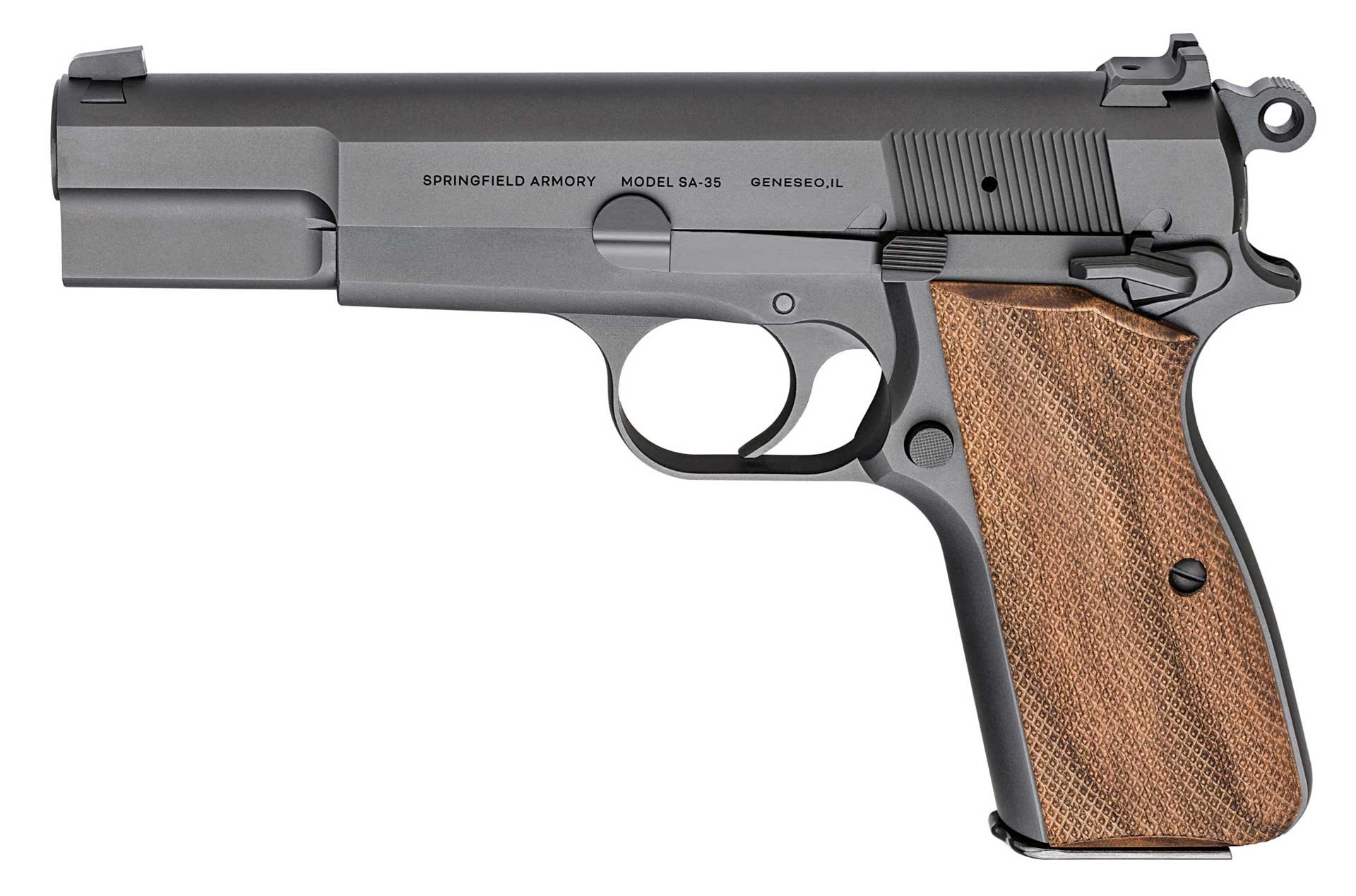
Since the new Belgian Hi-Powers are no longer produced between 2019 and 2022, GIRSAN, TİSAŞ and Springfield Armory, Inc. New clones have been designed by various firearms companies such as the other offering new skins, improved sights, redesigned hammers, curved magazine holders, improved trigger and increased magazine capacity.
In 2022, possibly to compete with the increased popularity of the Hi-Power, FN announced that they would continue production of the Browning Hi-Power. The 2022 "FN High Power" included a number of new features, including a fully versatile slide lock, a simplified removal method, an enlarged ejection port, a reversible magazine release, wider slide notches, different color coating offers and 17-round magazines. Contrary to popular belief, the new FN High Power may look like a modern Hi-Power, but it's actually a different design. One of the highlights is the lack of Browning-style locking grips.
The Browning Hi-Power was designed in response to a French military requirement for a new service pistol, the "Grand Rdemt" (French for "high efficiency") or alternatively the Grande Puissance (literally "high power"). The French army required:
The latter criterion was established to require a caliber of 9 mm or greater, a projectile mass of approximately 8 grams (123.5 grains), and a muzzle velocity of 350 m/s (1148 ft/s). All this was achieved with a weight of no more than 1 kg (2.2 lbs).
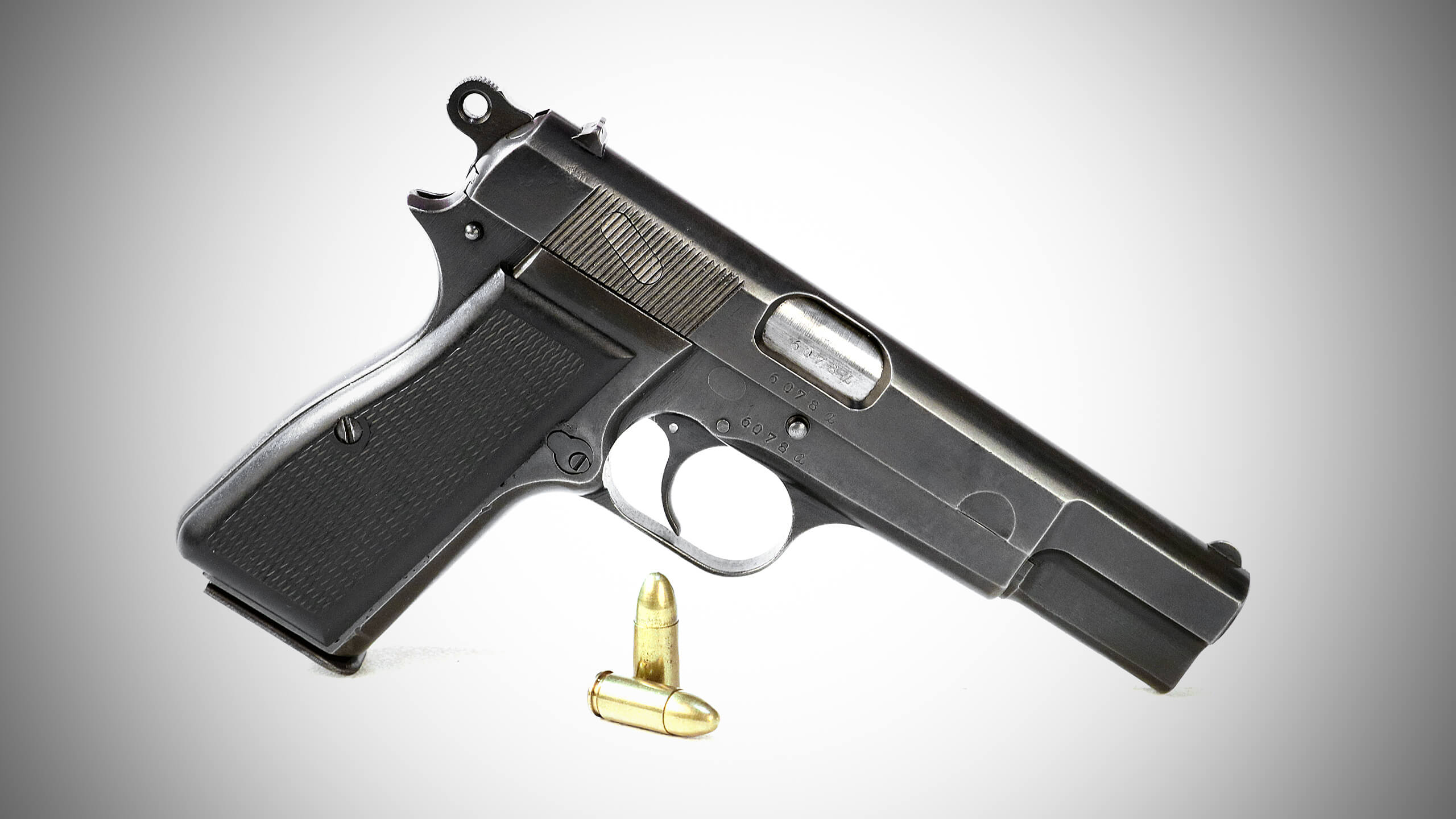
Browning High Power 9mm L9a1 Cold Cast Weapon. — Valour Works
FN commissioned John Browning to design a new military weapon with this specification. Browning had previously sold the rights to the US Army's successful M1911 automatic pistol to Colt's Patt Firearms, and so had to design an entirely new pistol while working around the M1911 firearms. Browning built two different prototypes for the project in Utah and applied for a patent for this gun on June 28, 1923 in the United States and was granted on February 22, 1927.
One was a simple recoil design, and the other operated with a locked reverse recoil system. Both prototypes used a new graduated magazine design (by designer Dieudonné Saive) to increase capacity without unnecessarily increasing the size of the pistol grip or magazine length.
The locking wedge design was chosen for further development and testing. This model was front-fired and had a double-stack magazine that held 16 rounds. The design was developed through several trials carried out by the Versailles Trial Commission.
In 1928, with the Colt Model 1911 patents expiring, Dieudonné Saive integrated many of Colt's earlier features into the Saive-Browning Model of the same year. This version had the Colt 1911's removable barrel cap and takedown row.
Browning High Power Pistol
In 1929, in an effort to find an alternative solution to the long-running Frch trials and to find other potential clichés, with a gun they believed was good enough to stand on its own, FN decided to declare it "Grand." Rdemt" has a 13-round short-circuit magazine for sale in their retail catalog. They were hoping to find a military contract to help them fund a production line, essentially using the same process as their previous FN M1900 pistols.
In 1931, the Browning Hi-Power design included the same 13-round magazine, a curved rear grip strap, and a barrel cap that was an integral part of the slide assembly. The Belgian army showed great interest and purchased 1,000 guns based on this prototype for field testing.
In 1934 the Hi-Power design was completed and ready to be manufactured. Ultimately, France decided against adopting the pistol and opted for the conceptually similar but lower capacity Modèle 1935 pistol. However, it was good enough to stand alone as a service pistol for the Belgian Army and other clits. These would become the Grande Puissance, known in Belgium as the High Power, for military service in 1935 as the Browning P-35.
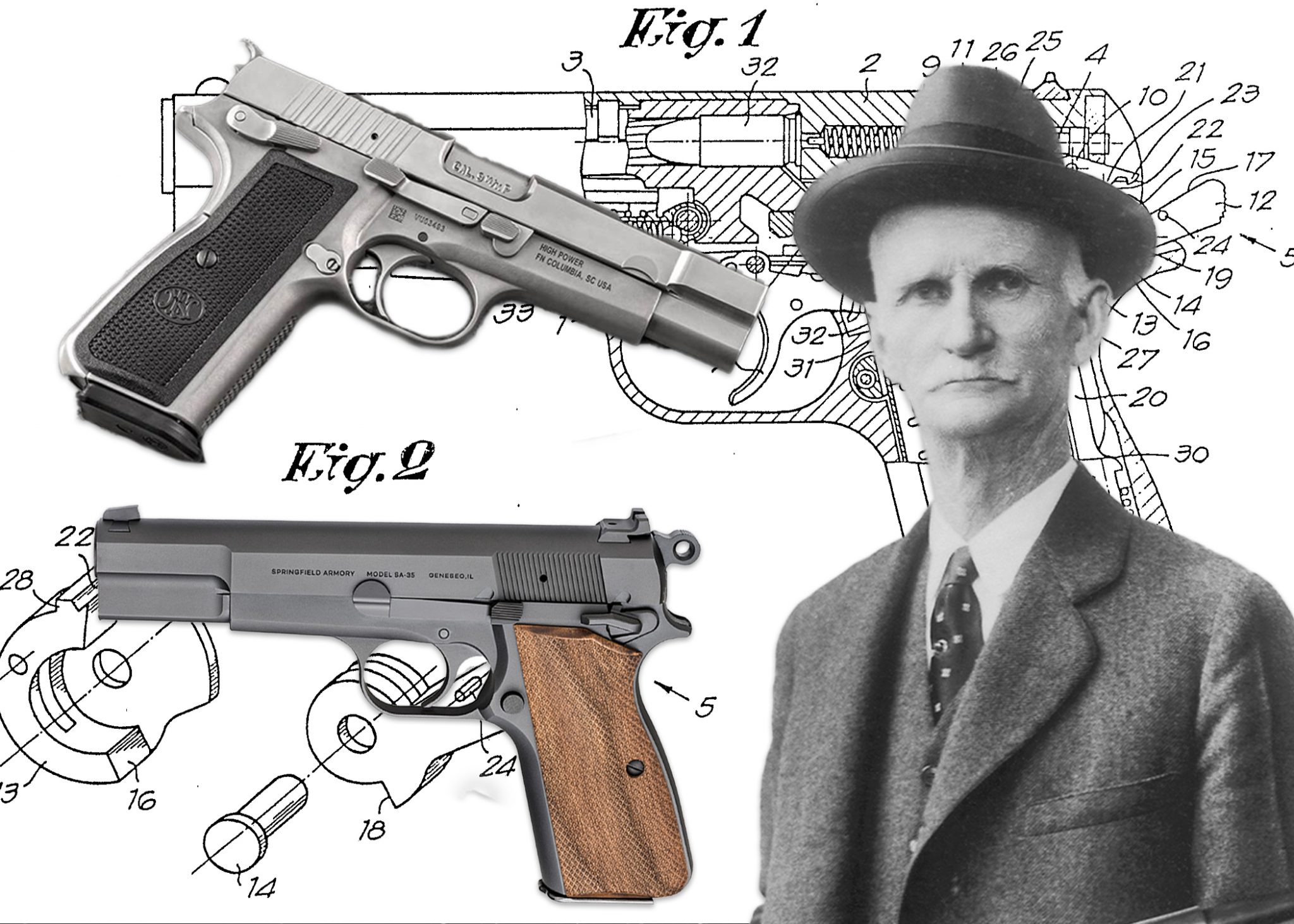
Browning Hi-Power Pistols, WWII. It was used by the Allied and Axis forces during World War II. After occupying Belgium in 1940, German forces took over the FN factory. German troops later used the Hi-Power and called it the Pistole 640(b) ("b" for belgisch, "Belgian").
Buy Inglis Diamond: The Canadian Hi Power Pistol Book Online At Low Prices In India
Examples produced by FN in Belgium under German occupation bear the German Inspection and Acceptance Marks, or Waffamts, such as WaA613. In German service it was mainly used by Waff-SS and Fallschirmjäger personnel.
A Browning Hi-Power decorated with the damask technique. One of the few models created was once the personal property of Muammar Gaddafi. The design refers to the Khamis Brigade.
High-powered guns were also manufactured in Canada for Allied use by John Inglis and Company of Toronto. Plans were extended from the FN plant to the UK, and it became clear that the Belgian plant would fall into German hands, allowing the Inglis plant to be equipped for Hi-Power production by for allied use. Inglis has produced two versions of the Hi-Power, one with an adjustable rear sight and detachable shoulder (primarily for the Chinese Nationalist contract) and the other with a fixed strut. Production began in late 1944 and was broadcast in March 1945 when Operation Varsity crossed the Rhine by air over Germany. The pistol was popular with the British Air Force as well as with covert operations and command groups such as the Special Operations Administration (SOE), the US Office of Strategic Services (OSS) and the Regiment of British Special Air Service (SAS). Inglis High-Powers built for the Commonwealth forces have the British designation "Mk 1" or "Mk 1*" and the manufacturer's details to the left of the slide. In British and Commonwealth service they were known as 'Pistol No 2 Mk 1' or 'Pistol No 2 Mk 1*' where appropriate. Serial numbers were 6 characters long, the second being the letter 'T', e.g. 1T2345. Gun serial numbers for the Chinese contract used the letters 'CH' but followed the same format apart from that. When the Chinese contract was cancelled, all undelivered Chinese-style pistols were accepted by the Canadian military as "Pistol No 1 Mk 1" and "Pistol No 1 Mk 1*".
In the post-war period, Hi-Power production continued at the FN plant and as part of the FN product range, which includes the FN FAL rifle and the FN MAG general machine gun. It has been adopted as the standard service pistol by more than 50 armies in 93 countries. At one time it was used by most NATO countries and was standard issue for Commonwealth of Nations forces. It has been produced under license or in some cases cloned on several continents. Former Iraqi ruler Saddam Hussein often carried a Browning Hi-Power. Former Libyan ruler Muammar Gaddafi carried a gold-plated Hi-Power with his own face design on the left side of the handle that Libyan rebels swung in the air after his death.
Browning High Power 9mm Pistol Stock Photo
Hi-Power, Pope II in 1981. It was used by Mehmet Ali Ağca during the assassination attempt on John Paul.
Although the Hi-Power remains an excellent and iconic design, it has been somewhat overshadowed since the early 1990s by more modern designs, often double-action with aluminum alloy frames and produced with more modern methods. However, Hi-Power continues to serve the world to this day. As of 2017, the MK1 version remained the standard service pistol of the Canadian Armed Forces, and the SIG Sauer P226 was issued to special units alongside the SIG Sauer P226.
Sig p365 tulster holster, sig p365 iwb holster, sig holsters p365, sig p365 sas holster, sig p365 xl holster, sig p365 hybrid holster, appendix holster sig p365, safariland holster sig p365, sig p365 belt holster, sig p365 holster, sig p365 purse holster, sig sauer p365 holster
0 Comments